

Why Parking Space Is Getting Harder to Find?
Parking has become one of the most practical challenges in urban India. Residential societies, commercial buildings, hospitals, hotels, and shopping complexes are all under pressure to accommodate more vehicles in less space. Conventional parking layouts — where each car gets its own marked bay with a driving lane beside it — are simply inefficient. A large portion of the floor area goes to lanes rather than cars. Mechanical parking systems change this equation. Two of the most widely used are the puzzle parking system and stack parking. Both increase capacity significantly over conventional layouts, but they work differently and suit different situations.
What Is a Puzzle Parking System?
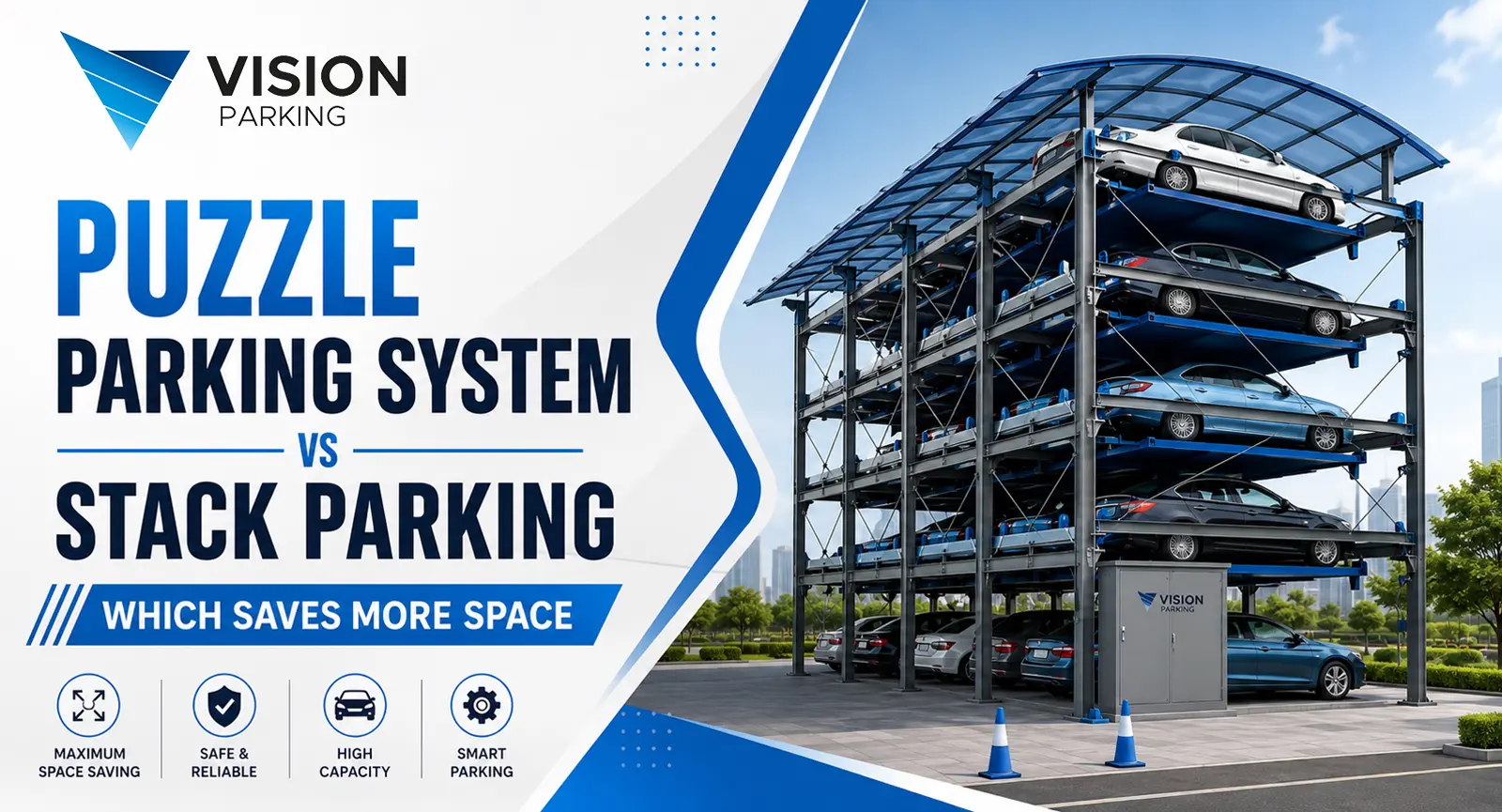
A puzzle parking is a multi-level mechanical parking structure where vehicles are stored on platforms arranged in a grid. The platforms move both horizontally and vertically — like a sliding tile puzzle — to shuffle cars into and out of position. One space in the grid is always kept empty, and the platforms slide around it to bring the required car to the ground level entry and exit point.
How it works:
- Vehicles drive onto a ground-level platform at the entry point
- The system’s PLC control shuffles the platforms to move the car into an available position
- When the driver returns, the system moves platforms again to bring the car back to ground level
- The driver collects the car from the same entry and exit point
Key characteristics:
- Operates on a grid typically 2 to 4 levels high and multiple columns wide
- Moves platforms both left-right and up-down to access any position
- Capacity ranges from around 6 vehicles for a small system to 50 or more for larger installations
- Suited for locations where the available floor area can accommodate a multi-column grid
- Requires a dedicated PLC control system and electric drive mechanism
What Is Stack Parking?
Stack parking is a simpler two-level system where one car is parked on a raised platform directly above another car on the ground. The upper platform lifts vertically on a hydraulic or mechanical mechanism to allow the lower car to enter or exit.
How it works:
- The upper platform lifts to allow ground-level access
- A car drives into the lower position
- The upper platform lowers over the lower car
- A second car parks on the upper platform
- To access the lower car, the upper platform lifts again
Key characteristics:
- Two cars per stack — one above, one below
- Pure vertical movement only — no horizontal shifting
- Suitable for any number of individual stack units placed side by side
- Simpler mechanism and lower cost per parking space than a puzzle system
- Best suited for residential complexes, small commercial buildings, and locations where two-level stacking meets the requirement
How Each Parking System Uses Space?
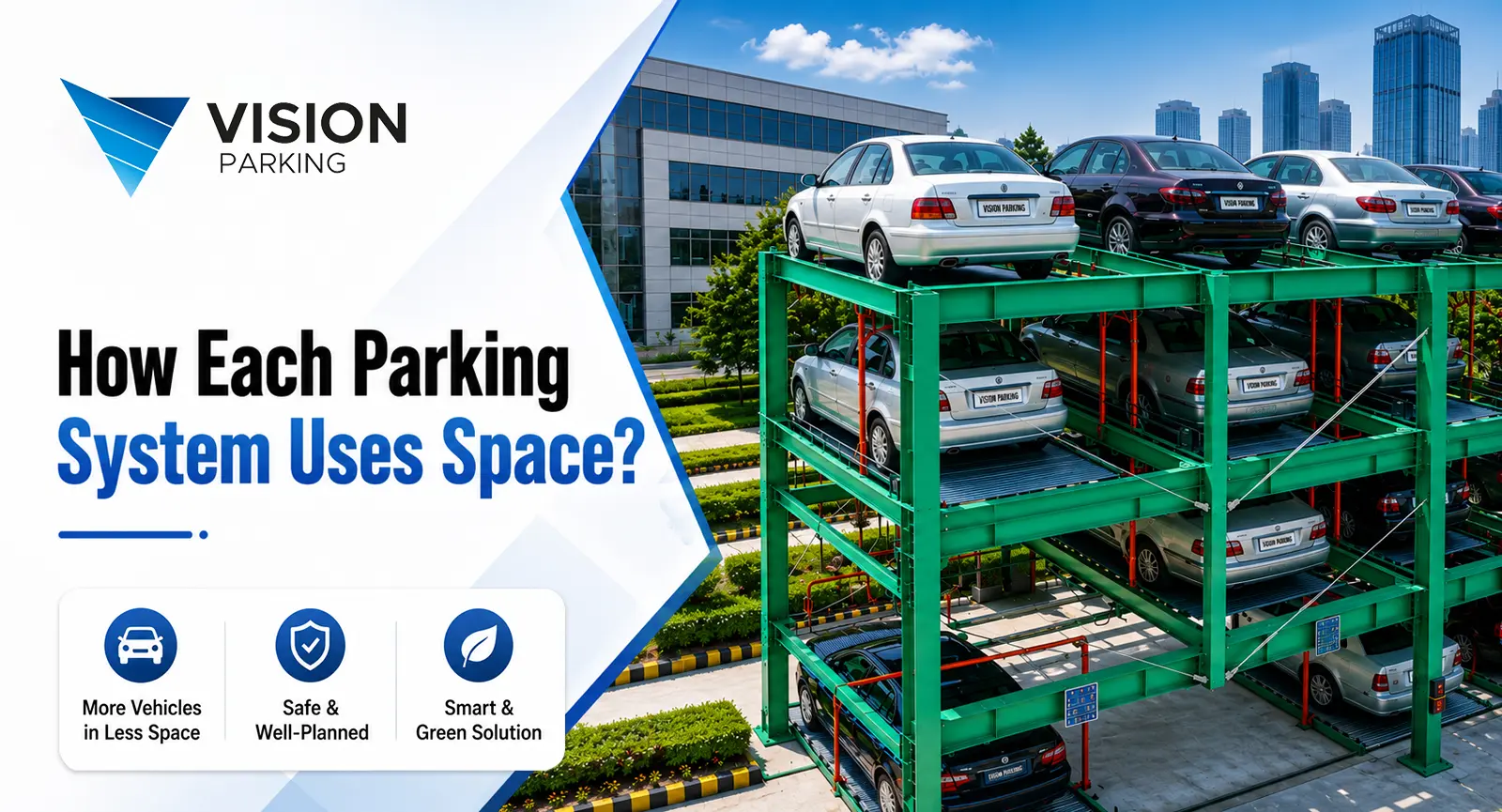
This is where the two systems differ most significantly.
Stack parking space efficiency: A standard stack parking unit parks two cars in the footprint of one conventional bay. The driving lane beside each unit is still needed — one car drives in and out, and the upper platform lifts to allow this. So the space saved is essentially one parking bay per stack unit.
Puzzle parking space efficiency: A puzzle parking system eliminates individual driving lanes almost entirely. The grid structure means cars are parked directly beside each other with no space between them for manoeuvring — because the platforms move mechanically. The one empty space in the grid does the work of an entire driving lane. This means a puzzle parking uses the available floor area significantly more efficiently per car than a stack system.
Simple comparison: In a 6m x 18m floor area, a conventional layout might accommodate 6 cars with lanes. A stack parking system in the same area could park around 10 to 12 cars. A puzzle parking system in the same footprint could park 18 to 24 cars or more depending on the configuration and number of levels.
Key Differences: Puzzle Parking System vs Stack Parking
| Factor | Puzzle Parking | Stack Parking |
| Movement | Horizontal and vertical | Vertical only |
| Levels | 2 to 4 typically | 2 only |
| Capacity per footprint | High | Moderate |
| Vehicles parked | 6 to 50+ per system | 2 per stack unit |
| Mechanism complexity | Higher | Lower |
| Installation cost | Higher | Lower |
| Best for | Medium to large requirements | Small requirements |
| Maintenance | More components | Simpler |
| Space efficiency | Higher | Moderate |
When Puzzle Parking Makes More Sense?
A puzzle parking system is the better choice when:
- The parking requirement is 10 vehicles or more — the space efficiency advantage of the puzzle system becomes more valuable as the number of vehicles increases
- Floor area is genuinely limited — when there isn’t enough space to add more conventional bays or additional stack units, the puzzle layout extracts the maximum capacity from the available footprint
- The site is multi-storey or has height available — puzzle systems use height efficiently with 3 or 4-level configurations
- The building is commercial, hospitality, or institutional — hotels, offices, hospitals, and commercial complexes where parking demand is consistently high benefit most from the higher capacity
- Long-term parking demand is expected to grow — a puzzle system installed with future capacity in mind can serve the site longer without requiring additional infrastructure
When Stack Parking Is the Better Choice?
Stack parking makes more sense when:
- The requirement is small — 10 vehicles or fewer, where the investment in a puzzle system isn’t justified by the capacity needed
- Budget is the primary constraint — stack parking delivers doubled capacity at significantly lower cost per space than a puzzle system
- The site is residential — individual apartments or small housing complexes where each resident needs one dedicated space work well with individual stack units
- Speed of retrieval is important — stack parking retrieves the lower car with no movement delay; upper car requires one lift cycle but is still faster than puzzle system retrieval in most configurations
- Ceiling height or structural constraints limit multi-level systems — stack systems need only enough height for two vehicles; puzzle systems need more depending on configuration
What to Consider Before Installing Either System?
Before deciding between a puzzle parking system and stack parking, work through these questions:
How many vehicles need to be accommodated?
This is the primary factor. Stack parking suits small numbers. Puzzle parking suits medium to large requirements.
What is the available floor area and height?
Both systems have minimum space requirements. A puzzle system needs a minimum footprint for the grid to function — too narrow and the system can’t work effectively.
What is the expected frequency of use?
A puzzle system in a high-frequency environment — a busy commercial building — needs to be sized and specified for the retrieval cycle times that match peak demand. Stack systems are simpler and fast for low to moderate frequency use.
What is the power supply situation?
Both systems require electrical power. Puzzle systems typically require more power and a more sophisticated electrical installation. Confirm power availability before finalising the system type.
What are the maintenance expectations?
Puzzle systems have more moving parts and more complex control systems — maintenance requirements are higher. Stack systems are mechanically simpler and easier to service.
What is the realistic budget including installation?
Get fully installed costs for both options against the parking capacity each delivers, then compare the cost per parking space — not just the total system cost.
Source Parking Systems from Vision
Vision Elevators Private Limited designs and supplies puzzle parking systems and stack parking systems for residential, commercial, and institutional applications — with site assessment, system design, installation, and after-sales maintenance support built into the supply process.
Frequently Asked Questions