

What Is a Hydraulic Puzzle Parking System?
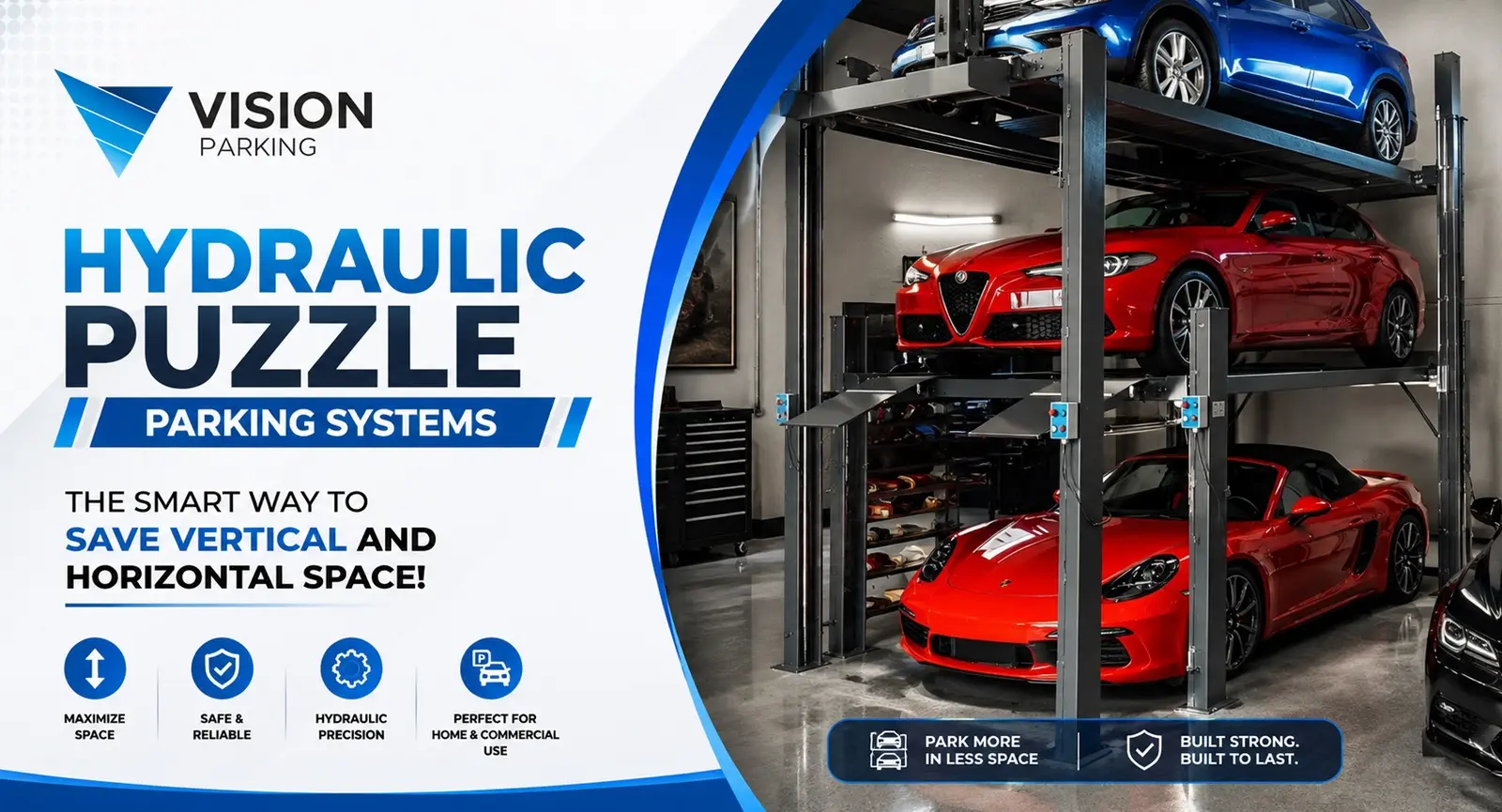
A Hydraulic Puzzle Parking System is a mechanical parking setup where cars are placed on pallets that move both sideways and up and down, almost like pieces in a sliding puzzle — which is really where the name comes from. Instead of every car needing its own fixed spot with a clear driving path, vehicles shift around within a grid, opening up space for one another as needed.
This kind of puzzle car parking system has become a common sight in cities where land is expensive and buildings simply can’t spare room for a large, flat parking lot. A hydraulic pump does the heavy lifting here, raising and lowering pallets so cars can be parked in layers rather than side by side across a wide open area.
How Does this Puzzle Parking System Work?
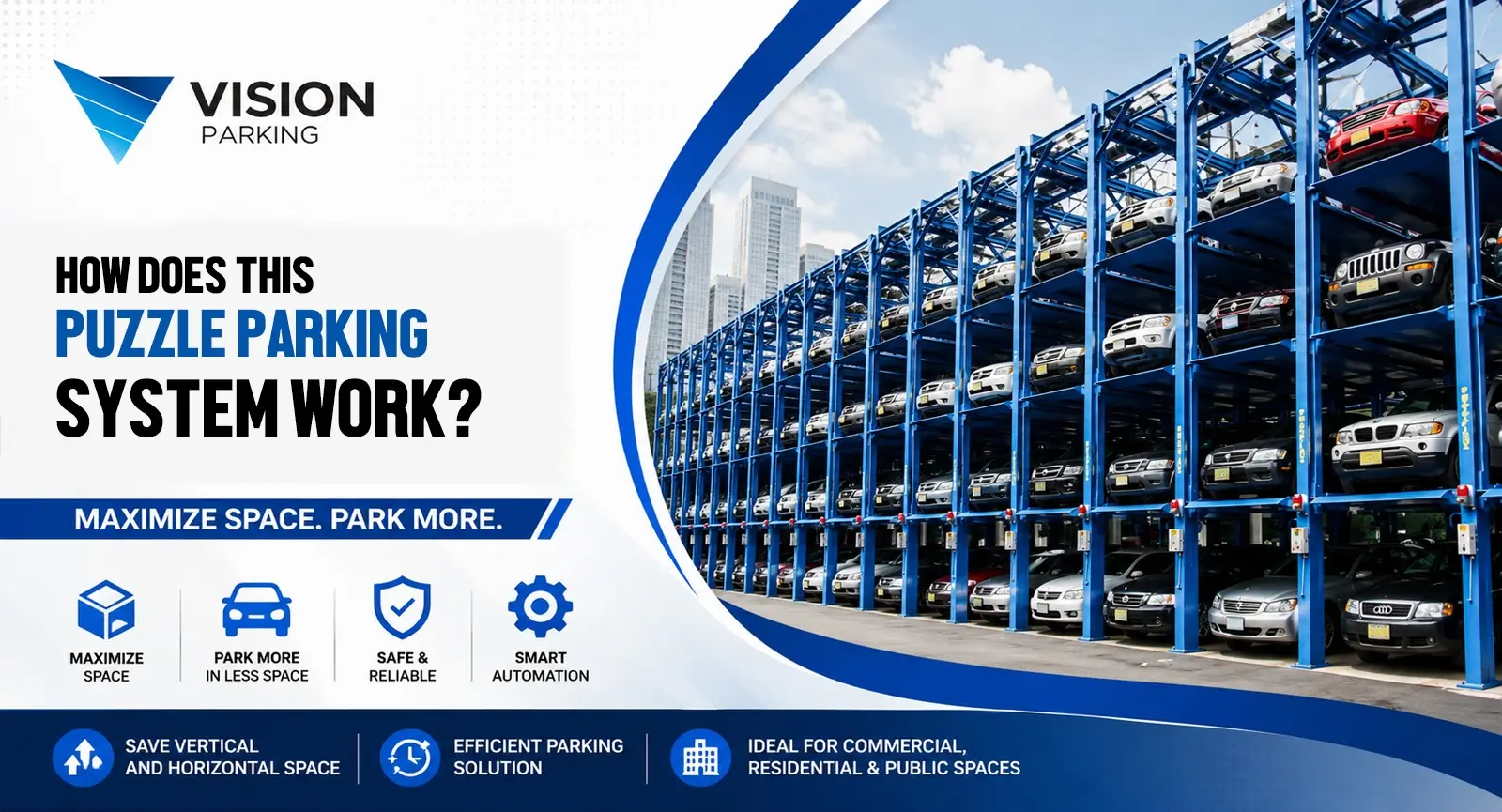
Because the hydraulic pump handles most of the heavy lifting, these systems can move fairly large vehicles without needing a huge amount of space around them, which is exactly why they work so well in tight urban plots.
The system runs on a grid of pallets arranged in rows and columns, with usually one or more empty spaces left open. Here’s roughly how hydraulic puzzle parking system works:
- The driver parks the car on an available pallet and exits
- When the car needs to be retrieved, the parking system’s control panel is used to select it
- Hydraulic motors shift the surrounding pallets sideways and vertically to clear a path
- The car’s pallet moves down to ground level, ready to be driven out
This entire process usually takes just a couple of minutes, which is quick considering how much space the multi-level parking system saves compared to manual parking.
Why Buildings Are Switching to Puzzle Parking
Traditional parking lots eat up a lot of land, and in cities, land is usually the most expensive part of any project. That’s the main reason more builders and property owners are turning to an automated puzzle parking system instead of a flat, open lot.
- It fits significantly more cars into the same amount of ground space.
- It reduces the need for wide driving lanes, since cars don’t drive themselves into each spot.
- It works well for both new construction and retrofitting older buildings with limited parking.
- It cuts down on the time drivers spend searching for a spot, since the system handles placement.
- It can be built vertically, which suits buildings where horizontal expansion simply isn’t an option.
For property developers, this often means being able to offer more parking within the same building footprint, which tends to matter a lot in commercial and residential projects where space is already tight.
Where Are These Systems Commonly Installed?
A multi-level hydraulic puzzle parking system shows up in a fairly wide range of settings these days.
- Residential apartment complexes, where the number of units usually outweighs available ground-level parking.
- Commercial office buildings, where employee and visitor parking needs to be managed efficiently.
- Shopping malls, where peak-hour crowds need quick and organized parking turnover.
- Hospitals, where space near the entrance is limited but parking demand stays high throughout the day.
- Hotels, where guest convenience matters, but land is often too valuable to spare for a traditional lot.
Because these systems scale up or down depending on the number of levels and pallets used, they end up working for small buildings and large complexes alike.
What to Check Before Buying a Puzzle Parking System
Not every hydraulic puzzle parking manufacturer builds these systems the same way, so it’s worth digging into a few details before you commit to one.
- Start with load capacity — make sure the system can actually handle the vehicles it’s meant to park, SUVs included if that’s what you’re expecting.
- Think about the number of levels too. More levels give you more parking, sure, but that also means more moving parts to keep maintained.
- Ask about retrieval time — how long does it usually take to bring a car back down during a busy hour? This matters more than people realize.
- Don’t skip safety features either. Sensors, alarms, automatic stops during pallet movement — these aren’t optional extras, they’re what keeps the system safe day to day.
- Find a hydraulic puzzle parking supplier who actually sticks around after installation, offering regular servicing and spare parts when you need them.
- And factor in power backup. Since the whole thing runs on hydraulics and electricity, a backup matters a lot if your area sees frequent power cuts.
Common Mistakes to Avoid
A few issues tend to come up repeatedly with buildings installing these systems for the first time.
- Underestimating the number of levels needed, which leads to space shortages within a few years.
- Skipping regular maintenance checks, which can slow down retrieval times over time.
- Not accounting for peak-hour usage, especially in buildings with high vehicle turnover.
- Choosing a system without checking long-term spare part availability.
- Ignoring driver training, since even a simple system works better when users understand how to park correctly on the pallet.
Final Thoughts
A hydraulic puzzle parking system genuinely solves a problem that’s only getting worse in most cities — there simply isn’t enough flat land to park every vehicle the old-fashioned way. It fits more cars into less space, works for a wide range of buildings, and once installed, it tends to hold up well with proper maintenance.
For anyone planning to install one, Vision Elevators Private Limited manufactures and supplies multi-level automated puzzle parking systems designed for both residential and commercial projects, with reliable engineering and support behind every installation.
FAQs